
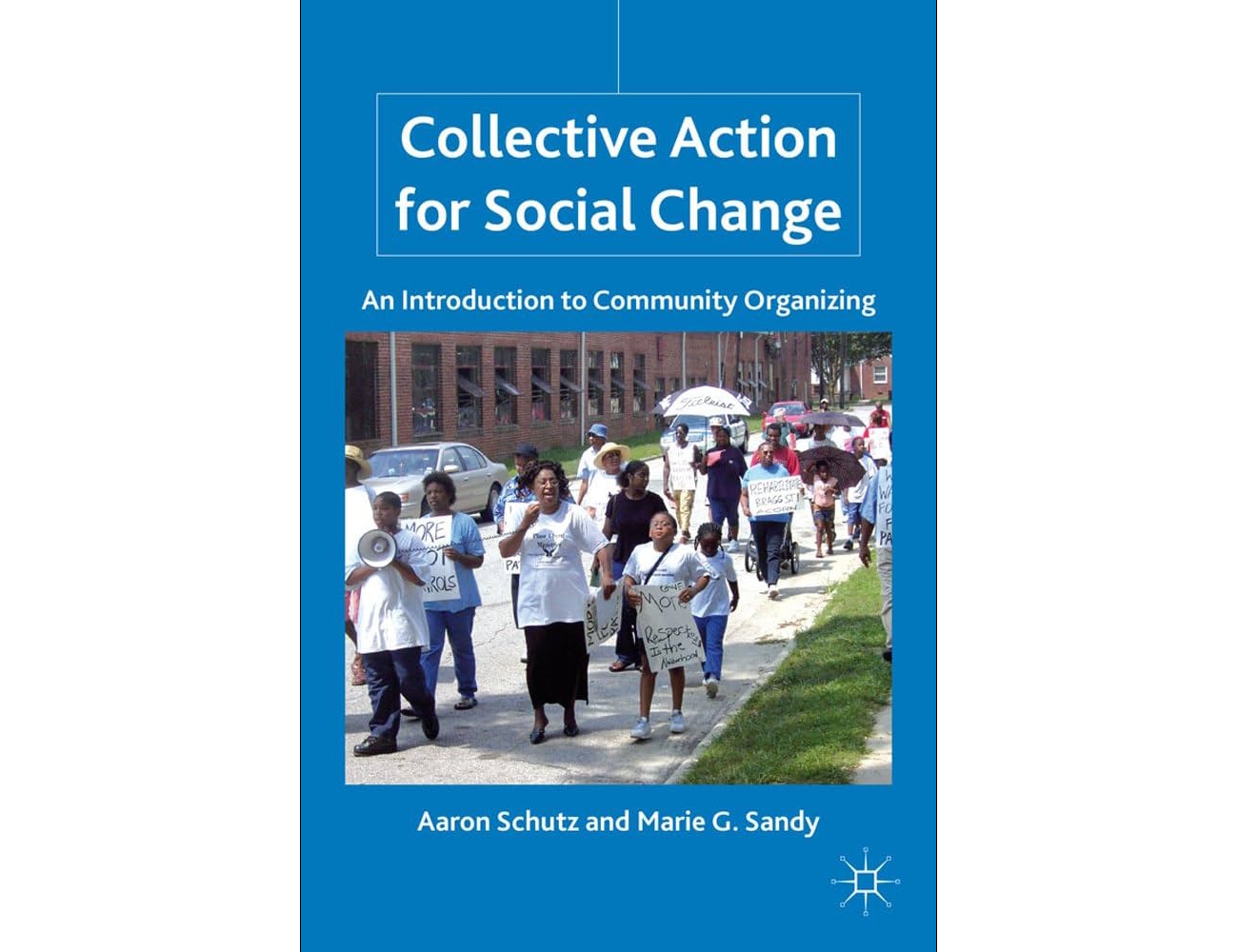
The world of science and research feels precarious right now and many of us feel compelled to act to protect it. A group of researchers and academics came together to see what we could learn from more traditional organizing to help us meet this moment. We read and discussed the book Collective Action for Social Change: An Introduction to Community Organizing (Schutz & Sandy, 2011), to understand what organizing is and how we could use it to fight the current challenges of shrinking funding and rising skepticism toward expertise. We wondered how researchers could build power and resilience collectively using community organizing principles. This book challenged our thoughts about power, leadership, and what it means to build resilience in research communities facing tough times. Here’s what stood out and why we think these organizing principles matter for scientists right now.
What Organizing Is (and Isn’t)
When we started this book, most of us realized we didn’t actually know what “organizing” was. We’d been to marches, volunteered, or built community in labs and classrooms, but the book quickly made clear that, while those things are important, they aren’t the same as organizing. Organizing is about building collective power that lasts. It’s about building groups of people who feel empowered to pressure those in power to enact changes they care about. A protest can burn off steam, but without sustained strategy and intentional development of leaders to keep it going, it rarely shifts structures. This means we need to move beyond isolated efforts, like a single petition or open letter, and toward building durable networks that can push for systemic change.
One member of our group summed it up with a story from their lab,
“If I got everyone in my group to pressure our advisor to change a decision, that would actually be organizing, because its people acting together to shift power.”
That example helped us to see how these tools might translate into academic life, where hierarchies and decision-making often feel beyond our control.
Power, Privilege, and Pressure
Effective organizing identifies who holds decision-making power and finds leverage points. The book gave an example of a talk show host who used racist language toward Latino/as. Angry community members protested the radio station, but a community organizer came to speak to them after. He challenged them to think about what the radio station really cares about: money. So after some thought, they decided to go after the radio station’s biggest sponsor instead.
So for academics, the questions are: Who funds, governs, or legitimizes our work and how do we influence them? Researchers tend to shy away from the word power. We picture CEOs, politicians, or funders hoarding it, but the book reframes power as simply “the ability to affect outcomes.” In a practical sense, power means organized people with organized money, because we are going up against giant corporations and organizations who have plenty of both. We must fight power with power. This way of thinking about power felt liberating, because it reminded us that we do have leverage, through things like collective bargaining, public trust in science, or coalitions across community and academic partners.
We also wrestled with dual identities. Many of us benefit from the privileges of higher education while at the same time critiquing the inequities it produces. Organizing doesn’t resolve that tension, but it gives us a framework to use strategically while staying accountable to broader communities. One important consideration is that more power and better conditions are never given to workers willingly. Efforts are underway that would greatly increase disparities in higher education, so the only way to fight this is to force the system to do the opposite. This work really needs to be done from within the system.
Lessons from History
The book had several chapters that chronicled the history of social movements that were helpful for long-term, big picture perspective. Descriptions of 20th century movements such as the Labor Movement, the Women’s Movements, and Civil Rights illustrated some recurring patterns:
Recurring patterns
- Movements rise, win some gains, then stall if they don’t pivot.
- Charismatic leaders can help, but centering a whole movement around them can be detrimental to the cause. Sustainable organizing builds many leaders.
- Coalitions succeed when they bridge divides, even when messy.
The most resilient movements built leadership across many people and connected with communities beyond their immediate base. That lesson resonated for us. Long-term impact requires shared leadership and clear systems to pass knowledge along, especially in areas with constant turnover of students and staff. History also reminds us that organizing is slow, imperfect, and often frustrating, but without it, nothing changes. Any progress is still progress and it is better than doing nothing at all.
Practical Takeaways for Researchers
From our reflections, a few principles felt especially relevant to us as researchers, scientists, and academics:
- Continuity matters: Any group that is made up of mostly temporary people, like students and post-docs, risks collapse when those people leave. Building structures for succession and knowledge transfer is essential.
- One-on-one chats build depth: Organizers don’t just recruit; they listen. We can do the same in our labs, departments, or teams to uncover what people actually care about.
- Pair stories with data: For scientists, data is often our bread and butter, but stories inspire action. Organizing reminds us to connect evidence to lived experience.
- Pick a lane: With so many challenges, funding cuts, misinformation, distrust, it’s easy to feel overwhelmed. Organizing teaches us to focus where we have the most leverage and build outward from there.
Closing
We read this book against a backdrop of rising uncertainty in academia. Cuts to funding, skepticism of experts, and polarizing public debates leave many of us feeling isolated. Organizing doesn’t make those challenges disappear, but it offers tools to face them together. It isn’t about having the perfect theory. It’s about taking action together, learning as you go, and building power over time. If we want to defend and sustain the work of science, we can’t do it alone. We need to organize, within our institutions, across disciplines, and alongside the communities our work serves. As one participant put it: “instead of asking: ‘Who will save us?’ we have to remember, no one is coming. We have to save ourselves.”
Acknowledgements
Funding for this project is provided by the RIOS Institute.