
A year ago today, many of us began to confront an unprecedented wave of challenges affecting the scientific community and the institutions that support education and research. Funding has been reduced, jobs have been lost, data have become harder to access, and programs have been scaled back or dismantled. The pace and volume of these disruptions have left many feeling overwhelmed and stuck, flooded by a constant stream of urgent developments demanding a response. With so much happening at once, it can be hard to know where to start. What can one person realistically do, and how do you sustain focus and purpose amid ongoing uncertainty?
In March 2025, with funding from the RIOS Institute, we initiated a working group to examine how best practices in community organizing could be applied to address this question. We began recruiting participants to a series of book clubs that would read four foundational books focused on community organizing and change-making. The idea was to use the clubs as a space to have conversations around how the lessons learned from the readings could be applied in the context of the work of STEM professionals.
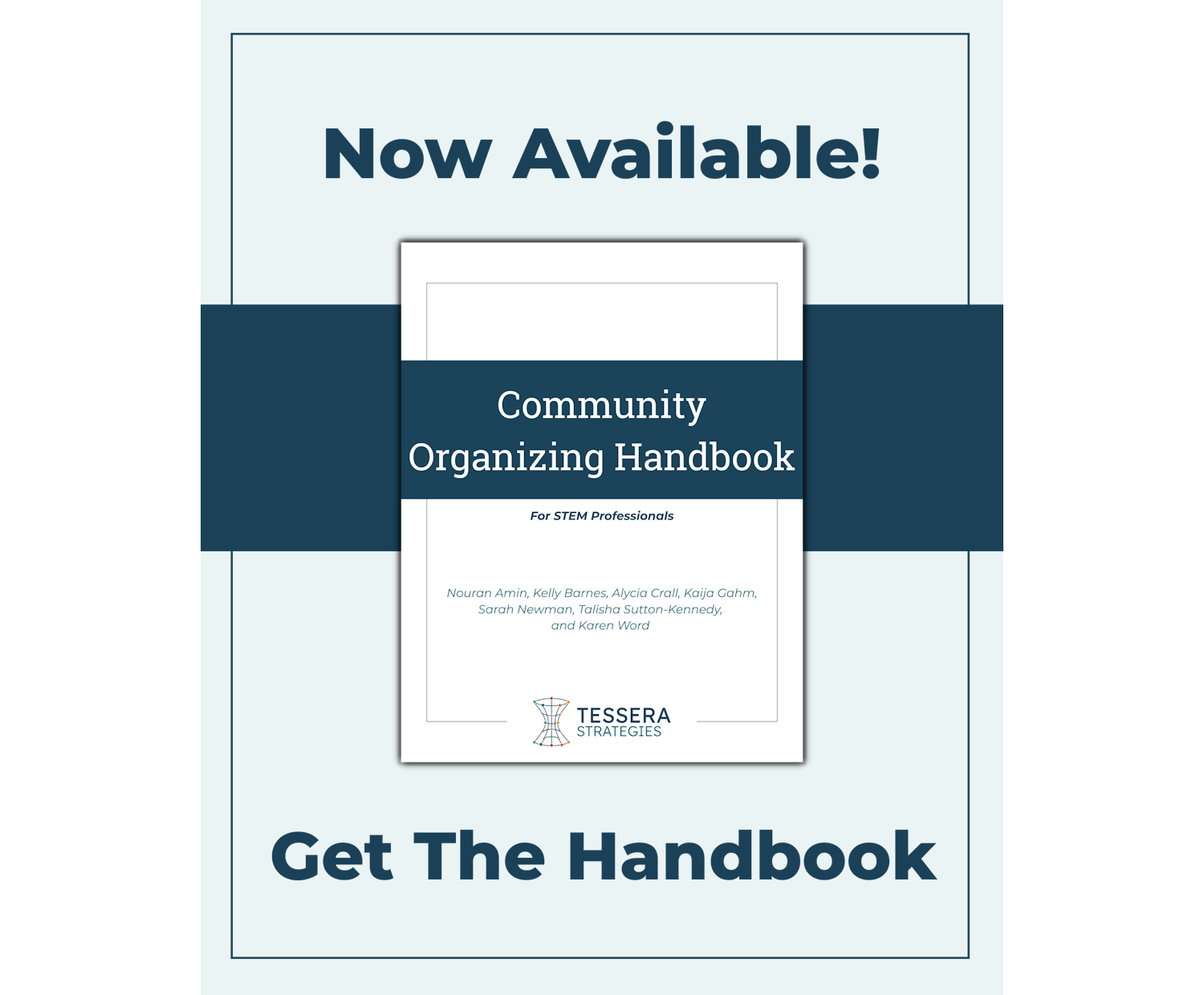
After five months of reading and discussion, three months of drafting, and two months of review and formatting, we are excited to announce that the handbook has been published!

What’s inside
Rather than offering abstract theory, the handbook is framed as a toolkit. It’s full of practical steps, real examples, and strategies, designed to help you transition from paralysis to action.
You’ll learn how to:
- Start small and learn as you go
- Create shared ownership by building a team and sharing leadership
- Build momentum through meetings that matter, clear messaging, and navigating resistance
- Fund the work with practical approaches to resourcing
- Sustain change by growing leaders, reflecting, celebrating progress, and planning for continuity
And because action is easier when you don’t have to start from a blank page, the handbook includes a robust set of ready-to-use worksheets: from clarifying your “why,” to planning listening sessions, to crafting a message that sticks.
How to use it
You can use this handbook however it fits your context:
- On your own, to spark ideas and plan the next step
- With a team, to reflect, coordinate, and share leadership
- In a study group, moving section by section
- In trainings or classrooms, grounding discussion in practice
There’s really no one right way to use the handbook; what matters is that it helps you get started.
Collective Learning to Collective Action
This handbook didn’t emerge from a single perspective; it’s a record of collective learning. Many individuals contributed their ideas, time, personal and professional experiences, and many aspects of themselves to its development. We hope this resource reflects their contributions well and that it supports others in making change where they are.
If you’ve been waiting for a sign to begin, this is it. Start with a conversation. Try something small, then reflect, adjust, and repeat. The handbook is here to support you in taking meaningful action, grounded in your context, your community, and the resources you already have.
Acknowledgements
Funding for this project is provided by the RIOS Institute.